

A Global Shift: How Countries Are Moving to Restrict Social Media Access for Children



Over the past two years, a growing number of governments have begun reconsidering how digital platforms should operate for young people. Concerns about cyberbullying, addictive platform design, exposure to harmful content, and youth mental health have prompted policymakers across multiple regions to explore stronger protections.
In December 2025, Australia became the first country in the world to implement a nationwide law preventing many social media platforms from permitting children under 16 from holding accounts. At the time, critics suggested Australia might be acting alone or moving too far ahead of the rest of the world.
Yet developments across Europe, Asia and the Pacific suggest the opposite. Far from standing out on its own, Australia’s regulation triggered a rapidly emerging international policy movement. Governments across multiple jurisdictions are now exploring similar restrictions, experimenting with different regulatory approaches, and in some cases, proposing even stronger forms of platform accountability.
For schools, parents and policymakers, this broader international context is important. It shows that the focus on mental health and social media is no longer confined to one country but has become a global conversation about how digital environments should be designed and governed for public health.
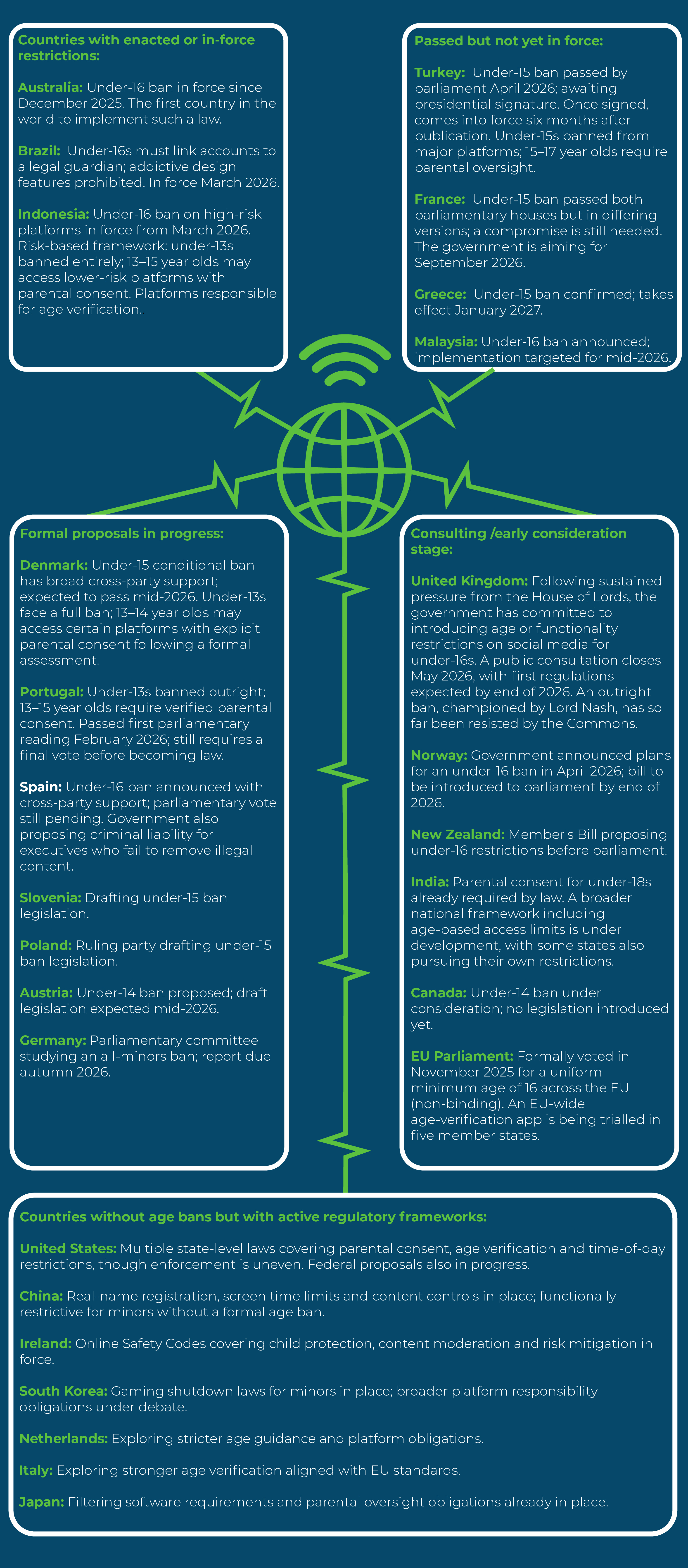
Australia: The first nationwide social media age restriction
Australia’s legislation, introduced under the country’s online safety framework, requires social media companies to take “reasonable steps” to prevent users under the age of 16 from holding accounts. The reform was driven by growing evidence linking heavy social media use among adolescents to cyberbullying, sleep disruption, anxiety and depression, and by a growing recognition that today’s platforms are not neutral tools but systems engineered to maximise engagement, often at the expense of young people’s mental health and development.
When the ban came into force on December 10, 2025, Prime Minister Anthony Albanese marked the moment, telling the Australian Broadcasting Corporation:
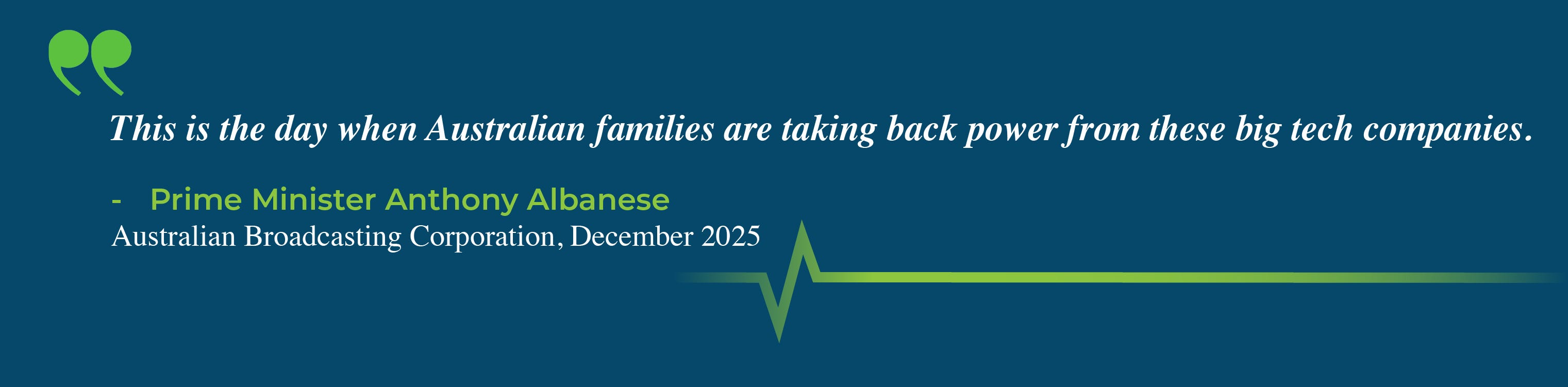
The law passed with bipartisan political support and the backing of approximately three-quarters of Australian parents.
Responsibility for enforcing the law sits with the eSafety Commissioner. Penalties for non-compliance fall on platforms rather than children or parents, with fines of up to A$49.5 million for systemic breaches. Critically, the law places accountability on the companies that design these environments, not on the children navigating them, or the parents trying to protect them.
Since coming into force, Australia’s law has had an immediate international impact, with policymakers in multiple countries explicitly citing the Australian model while developing their own proposals. Rather than an isolated initiative, it appears to have triggered a rapidly emerging international policy movement.
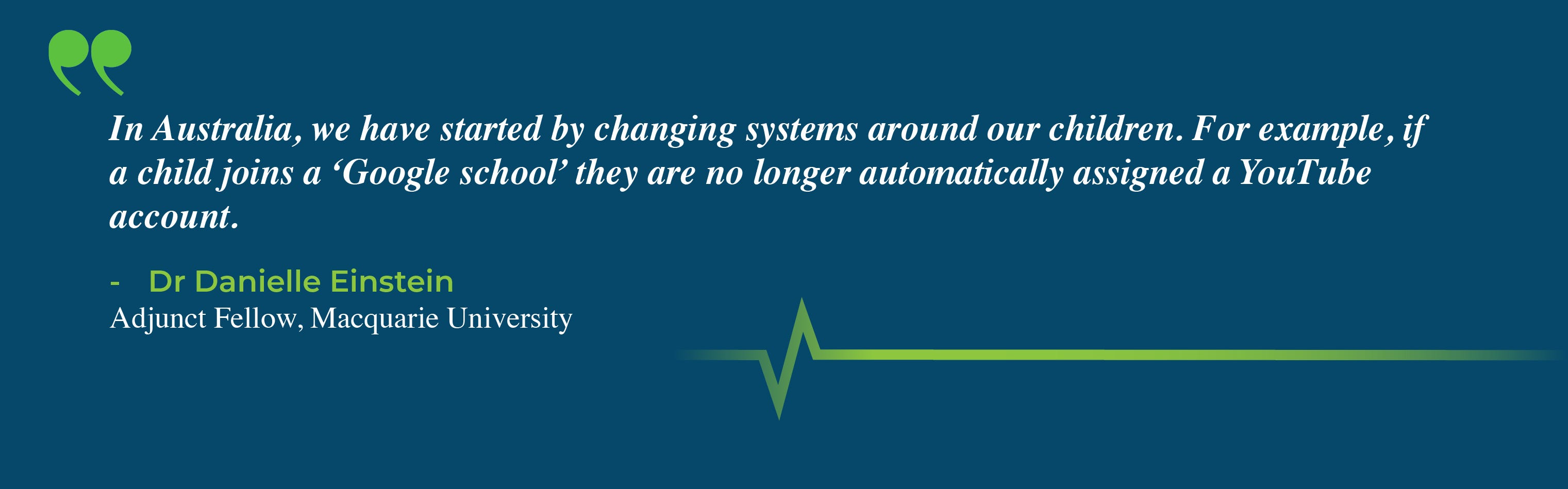
Brazil: Reshaping the internet for children
In September 2025, Brazil passed its first dedicated law protecting children’s online privacy and safety, driven not by government initiative but by national outrage. A viral video by influencer Felca, viewed more than 52 million times, exposed YouTube channels profiting from sexualised content featuring children. Public response was immediate, and the legislation passed with support from all but one political party.
Brazil’s Digital Statute for Children and Adolescents, known as the ECA Digital, came into force on March 17, 2026. Rather than imposing an outright age ban, it takes a broader approach: requiring technology companies to design products in children’s best interests, prohibiting behavioural advertising targeting minors, banning manipulative design features that encourage compulsive use, and requiring under-16 accounts to be linked to a legal guardian. Loot boxes in games aimed at minors are also prohibited, a provision tech lobbyists unsuccessfully attempted to remove before the final vote.
Hye Jung Han, children’s rights and technology researcher at Human Rights Watch, captured the significance of the moment:
Companies that fail to comply face fines of up to US$9.4 million or 10% of their Brazilian revenue, with suspension or a full ban as a last resort. Formal enforcement begins November 2026.
Indonesia: A risk-based approach in force
Indonesia’s PP Tunas regulation came into effect on March 28, 2026, making it one of the few countries outside Australia with enforceable social media age restrictions already operating. The government’s message was simple and deliberate: wait until children are ready.
Rather than a blanket ban, Indonesia’s approach varies restrictions according to how harmful a platform is assessed to be for children. Under-13s are banned from all covered platforms. Those aged 13 to 15 may access lower-risk services with parental consent, while under-16s are blocked entirely from high-risk platforms including TikTok, Instagram, Facebook, YouTube, X and Roblox. Platforms are responsible for age verification, and behavioural advertising targeting minors, manipulative design features and privacy violations are all prohibited.
As Minister of Communication and Digital Affairs Meutya Hafid put it:
Turkey: Legislation passed in the wake of tragedy
Turkey’s parliament passed an under-15 social media ban in April 2026, fast-tracked following two school shootings, the second of which involved a 14-year-old who killed nine students and a teacher at a school in Kahramanmaraş. The connection between social media and youth violence had already been a growing concern in Turkey, with President Erdoğan publicly describing platforms as places that were “corrupting our children’s minds.”
Under the law, platforms including YouTube, TikTok, Facebook and Instagram are prohibited from offering services to under-15s and must implement age verification systems and parental control tools. Children aged 15 to 17 can access platforms but within a child-specific framework requiring parental oversight, including monitoring of usage time and consent for purchases.
The law is awaiting presidential signature. Once signed, it will come into force six months after publication, meaning full enforcement is unlikely before late 2026.
The legislation has not been without controversy. Turkey’s main opposition party voted against the bill, arguing that children are better protected through education and rights-based policies than outright bans.
France: A near-finalised ban for under-15s
France has been one of the most vocal advocates for stronger social media age restrictions, with President Macron citing Australia’s law as a model and pushing for rapid legislative action. The National Assembly passed the bill in January 2026 by a vote of 130 to 21, requiring all social media platforms to refuse new users under 15 and suspend existing accounts belonging to children under that age.
The Senate has since passed its own version of the bill, though the two chambers adopted differing approaches. Both houses will need to reach a compromise before the law can be finalised, and even once adopted, questions remain about how the ban could be enforced in practice. The government is targeting September 2026, the start of the French school year, as the date for the ban to come into force for new accounts, with existing underage accounts to be deactivated by the end of 2026.
The legislation also goes beyond social media. It includes a proposal to extend France’s existing mobile phone ban, already in place in primary and middle schools since 2018, to high schools, reflecting broader concerns about screen time and digital wellbeing among young people.
Greece: Protecting children from addictive design
In April 2026, Greek Prime Minister Kyriakos Mitsotakis announced that Greece will ban children under 15 from social media from January 1, 2027. The decision was framed explicitly around mental health, the exhaustion young people feel from constant comparison, the pressure to always be online, and the harm caused by platforms built to capture attention rather than support wellbeing.
Mitsotakis was direct about where responsibility lies: the goal, he said, is not to burden children or families, but to pressure platforms to change.
Under the policy, children under 15 will be prohibited from holding accounts regardless of parental consent, a harder line than many comparable laws, and one that places enforcement squarely on platforms rather than families. Companies that fail to comply could face fines of up to 6% of their global turnover under the EU’s Digital Services Act.
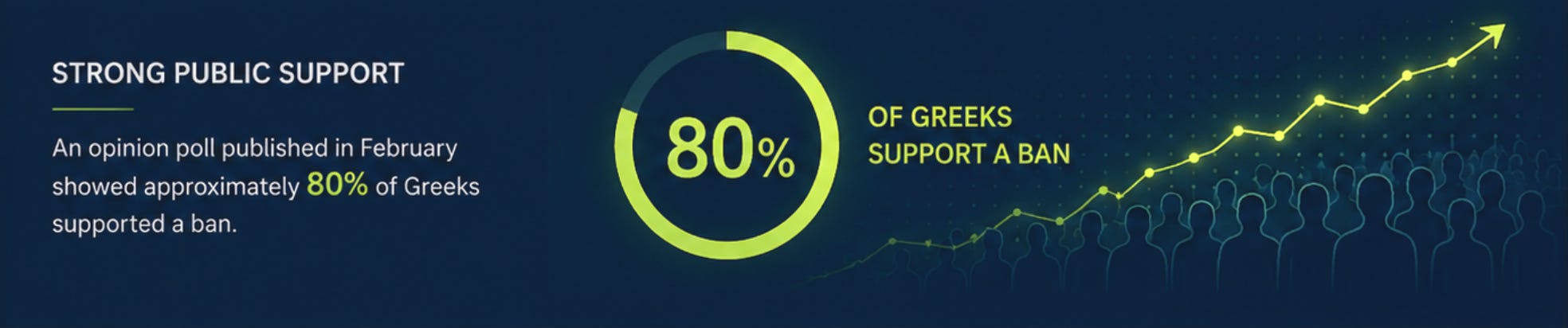
The political decision has been made, but the full legal framework is still to follow. The legislation will go to public consultation before being voted on in the Greek parliament in mid-2026, ahead of the January 2027 start date. An opinion poll published in February showed approximately 80% of Greeks supported a ban, a level of public backing that mirrors what was seen in Australia before its own law passed.
Malaysia: Following Australia’s Lead
Malaysia’s Online Safety Act 2025 received royal assent in May 2025 and came into effect on January 1, 2026, providing the legal foundation for an under-16 social media ban. Full enforcement of the age restriction, including mandatory electronic identity verification using government-issued documents such as the MyKad identity card and national digital ID, is targeted for mid-2026.
Rather than an outright ban, Malaysia’s approach has been described as “delay, not delete” — mirroring the Australian model, under which accounts are quarantined rather than removed until a user reaches the legal age threshold. Under-16s will not be able to manage accounts independently but may retain supervised access under parental oversight. Social media platforms with at least 8 million local users are required to obtain a licence, with fines of up to RM 500,000 and potential jail terms for officers of non-compliant companies.
Denmark: Cross-party support for a conditional ban
Denmark’s push for legislation has been driven in part by striking data. According to the Associated Press, Denmark’s Minister for Digital Affairs Caroline Stage said 94% of Danish children under 13 have profiles on at least one social media platform, and more than half of those under 10 do. For policymakers, this made clear that existing age limits set by the platforms themselves had fundamentally failed.
The government has since secured broad cross-party parliamentary support for an under-15 conditional ban. Under the proposed model, under-13s would face a full ban, while 13 and 14-year-olds could access certain platforms only with explicit parental consent following a formal assessment. Major platforms covered are expected to mirror the Australian model, Instagram; TikTok, Facebook, Snapchat and X, though a definitive list has not yet been confirmed.
Minister Stage has been clear that the government’s concern is the overwhelming commercial influence of platform design on young users — an influence it argues that “no parent, teacher or educator can stop alone.”
Legislation is expected to pass by mid-2026. The government has been deliberate about the pace, emphasising that it will move quickly but carefully to ensure the law is robust and leaves no loopholes for tech companies to exploit.
Spain: Going further than age limits alone
In February 2026, Spanish Prime Minister Pedro Sánchez announced a sweeping package of measures to restrict children’s access to social media and hold technology companies to account, going significantly further than the age-based bans proposed elsewhere.
Speaking at the World Governments Summit in Dubai, Sánchez announced that Spain will ban social media access for children under 16, with platforms required to implement “real barriers that work — not just checkboxes” for age verification. He framed the moment in stark terms: “Our children are exposed to a space they were never meant to navigate alone — a space of addiction, abuse, pornography, manipulation and violence. We will no longer accept that.”
But the under-16 ban is only one part of a broader package. Spain is also proposing to make technology executives face personal criminal liability for failing to remove illegal or hateful content, and to criminalise the deliberate algorithmic amplification of harmful material. If adopted, these measures could become some of the first attempts anywhere in the world to extend platform accountability beyond corporations to the individuals who run them. The full package still requires parliamentary approval before becoming law.
Portugal: A consent-based model
Portugal’s proposed framework takes a different approach to most; rather than an outright ban, it requires verified parental consent for 13- to 15-year-olds, with under-13s banned entirely. The bill passed its first parliamentary reading in February 2026 and still requires a final vote before becoming law. If passed, platforms that fail to comply could face fines of up to 2% of their global revenue, a lower penalty threshold than most comparable legislation, but a meaningful step toward platform accountability.
Austria: The lowest proposed age threshold
Austria has proposed an under-14 ban, the lowest age threshold of any country currently considering legislation. The proposal reflects growing concern among Austrian policymakers about the impact of social media on younger children, and a draft bill is expected by mid-2026. Austria has proposed an under-14 ban, the lowest age threshold of any country currently considering legislation, with a draft bill expected by mid-2026.
Slovenia: Drafting underway
Slovenia is drafting legislation to restrict social media access for under-15s, with experts in education and digital technology being consulted throughout the process. While Slovenia is a smaller country, its move is significant as part of a broader pattern of Central and Eastern European nations, alongside Poland and others, beginning to take legislative action on children’s social media use.
Germany: A cautious and constitutional approach
Germany is taking the most measured approach of the group. A parliamentary committee is studying the case for an all-minors ban without parental consent exemptions, with a report due in autumn 2026. The pace reflects a genuine legal complexity, as Germany’s constitution gives parents significant rights over their children’s upbringing, meaning any legislation may face court challenges. As Europe’s largest economy, how Germany resolves these tensions will likely shape any future EU-wide framework.
The United Kingdom: A commitment to act, but the job is not yet done
The UK debate around children and social media has moved significantly in recent months, driven in large part by sustained pressure from the House of Lords. Following repeated defeats in the Lords, led by Lord John Nash, the government has now committed to parliament to introduce some form of age or functionality restrictions on social media for children under 16. As Lord Nash has noted, this is “further than they have ever gone before, but the job is not yet done.”
The commitment followed a lengthy parliamentary standoff. Lord Nash’s amendment to the Children’s Wellbeing and Schools Bill, which would have required the government to raise the social media age to 16 within 12 months, was passed by the Lords four times and rejected by the Commons each time. The government ultimately agreed to introduce some form of age or functionality restrictions, but stopped short of Lord Nash’s original amendment, giving itself significantly more time to act than he had proposed.
The next stage centres on the consultation launched in March 2026, which closes in late May. The government has said it will update parliament on its plans by summer 2026, with a first set of regulations in place by the end of the year.
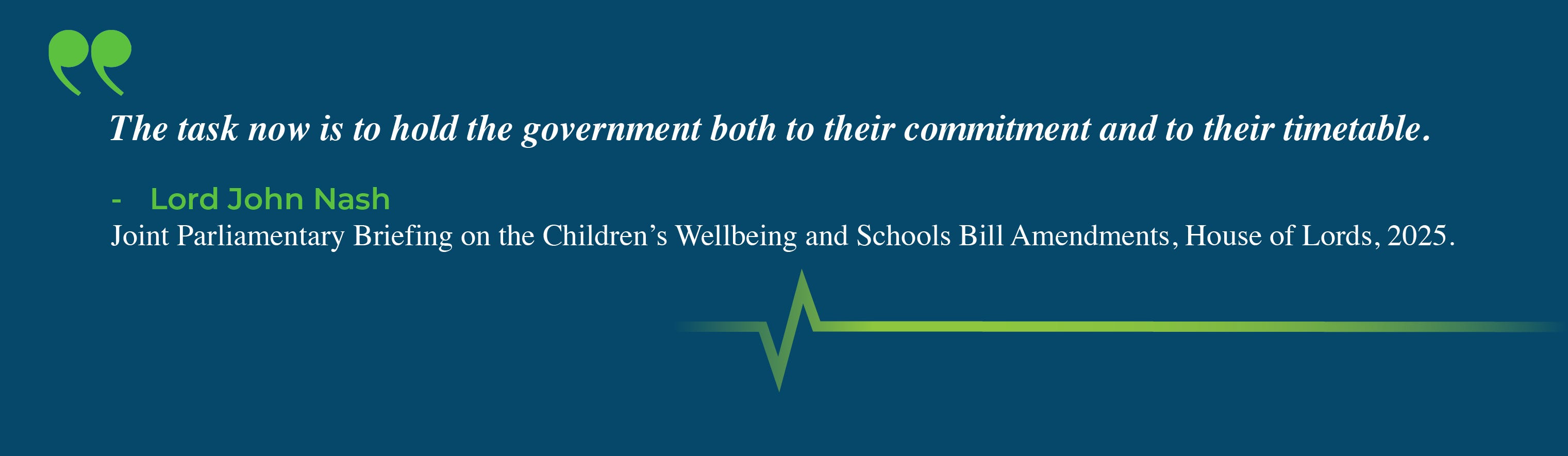
The consultation is examining a list of harmful platform features that would be restricted for under-16s, including endless scrolling, autoplay, likes and comments, push notifications, personalised content feeds, live streaming, disappearing messages, location sharing, and contact with strangers. The goal, as Lord Nash has described it, is that "children under 16 will cease to be exposed to platforms that utilise these harmful features."
The Raise the Age Campaign UK calls for a higher minimum age for access to social media and other digital platforms, arguing that existing safeguards have not kept pace with the rapid evolution of digital environments. Crucially, the campaign highlights a point increasingly recognised by policymakers: children’s online experiences are not confined to individual platforms. Young people move fluidly between social media, gaming, messaging apps and other digital services, protections must address the broader digital ecosystem, not just individual platforms in isolation.
This wider perspective is now reflected in the policy debate itself. Policymakers are increasingly examining whether similar protections should extend to online gaming environments, where young users interact with algorithmic recommendation systems, in-game social features, and monetisation mechanisms such as loot boxes and microtransactions, systems that can replicate many of the same behavioural design dynamics found on social media platforms.
Norway: Government commits to under-16 legislation
In April 2026, Norway’s Prime Minister Jonas Gahr Støre announced that his government will introduce legislation banning children under 16 from social media before the end of the year. The announcement came in response to what the government described as “overwhelming” public demand, with Norway’s own research showing that despite an existing minimum age of 13, over half of nine-year-olds in the country are already active on social media platforms.
Under the proposed law, the responsibility for age verification would sit squarely with technology companies rather than parents or children. The bill would also allow children to begin using social media on 1 January of the year they turn 16, a practical approach designed to avoid confusion around individual birthdays.
Prime Minister Støre framed the announcement in clear terms:
New Zealand: Parliamentary momentum building
New Zealand’s path toward a social media age restriction has been driven by a combination of parliamentary inquiry and a Member’s Bill. National MP Catherine Wedd’s Social Media (Age-Restricted Users) Bill, modelled closely on Australia’s law, proposes banning under-16s from social media and placing responsibility for age verification on platforms.
A parliamentary select committee inquiry into online harm delivered a final report in early 2026, which strongly supported the ban, concluding that “online harm is a public health issue that requires collective attention from government, businesses, online platforms and civil society.” The committee also called for a single national online safety regulator with sufficient powers to hold platforms to account.
Prime Minister Christopher Luxon has expressed strong personal support for the bill. However, coalition partner ACT opposes an outright ban, making passage uncertain in an election year. The committee itself acknowledged that New Zealand, as a small country, cannot act effectively alone and called for alignment with international partners as part of a coordinated global response.
India: Parental consent already law — broader framework coming
Parental consent for under-18s is already required under India’s Digital Personal Data Protection Act. A broader national framework covering platform design obligations and age-based access limits is under active development, with some states also pursuing their own restrictions.
Canada: Building toward legislation
Canada’s debate has moved considerably since Australia’s law came into force. Federal officials drew up plans in early 2026 to include an under-14 social media ban in the upcoming Online Harms Bill, and the Liberal Party has since passed a non-binding resolution calling for a minimum age of 16. No legislation has yet been introduced, though 75% of Canadians support a full ban for under-16s according to a March 2026 Angus Reid Institute poll.
The European Union: Pushing for a common standard
While individual European countries have been moving at different speeds, pressure is building for a coordinated EU-wide response. In November 2025, the European Parliament voted 483 to 92 in favour of a non-binding resolution calling for a minimum age of 16 across all member states. Under-13s would be banned outright; 13 to 15 year olds could access platforms only with parental consent, enabling parents to actively monitor their children’s digital activity. The vote reflected striking public backing, over 90% of Europeans consider protecting children online a matter of urgency, according to the 2025 Eurobarometer.
MEP Christel Schaldemose, who led the Parliament’s push, captured the political mood: “We are finally drawing a line. We are saying clearly to platforms: your services are not designed for children. And the experiment ends here.”
The European Commission has also moved beyond statements. In April 2026, Commission President Ursula von der Leyen told platforms there were “no more excuses” and confirmed that the EU’s own age-verification app is technically ready for rollout, an open-source tool that confirms a user’s age without exposing personal data, compatible with major platforms including TikTok, Instagram and Facebook.
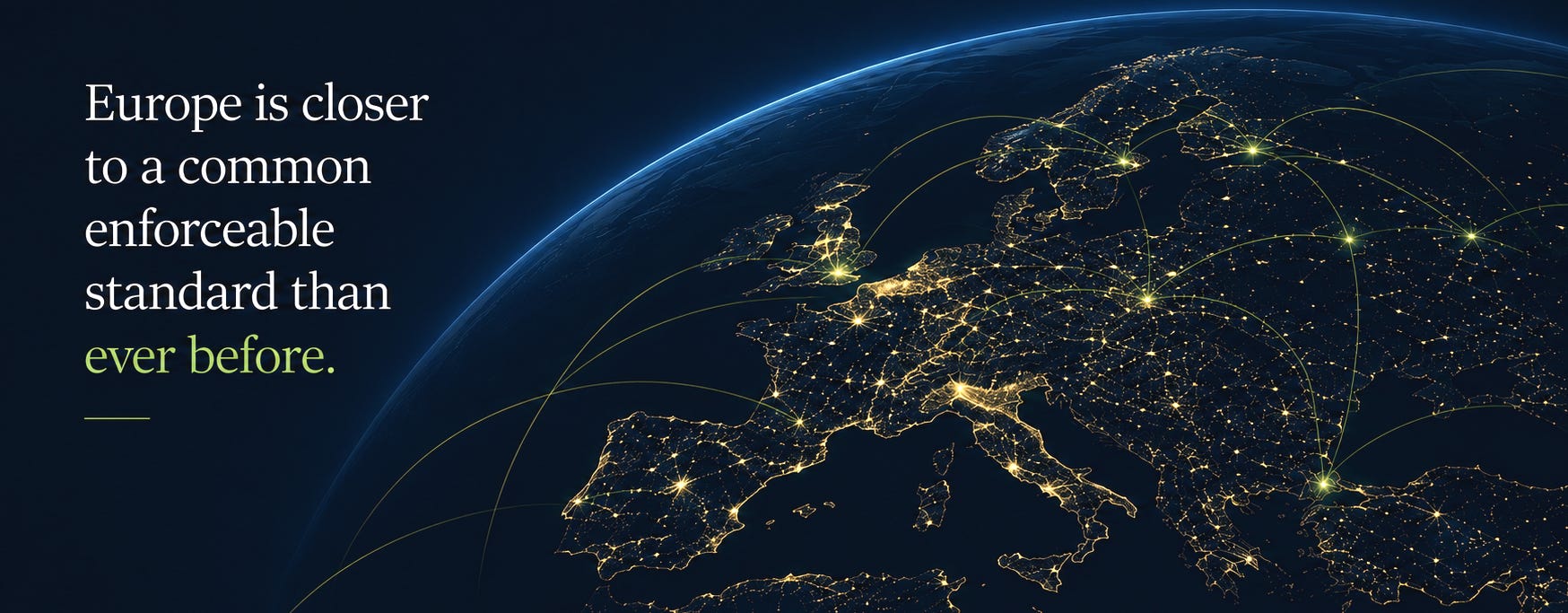
While binding EU-wide legislation is still to come, the combination of political momentum, national bans across multiple member states, and a technically ready verification tool suggests the EU is closer to a common enforceable standard than at any previous point.
A rapidly evolving global policy conversation
Looking across these developments, a clear pattern is emerging. Governments are no longer asking whether to act on children’s social media use, they are asking how. The approaches vary: some countries are pursuing outright age-based bans, others are focusing on parental consent frameworks, data protection rules, restrictions on addictive platform design features, or broader ecosystem regulation extending to gaming and other digital services.
Rather than converging on a single model, policymakers appear to be learning from one another, adapting elements of different approaches to suit their own legal and social contexts. Australia’s law has been cited explicitly by governments in Europe, Asia and the Pacific. Spain’s proposals on executive liability are being watched by regulators internationally. The EU’s age-verification technology is being built to serve the whole continent.
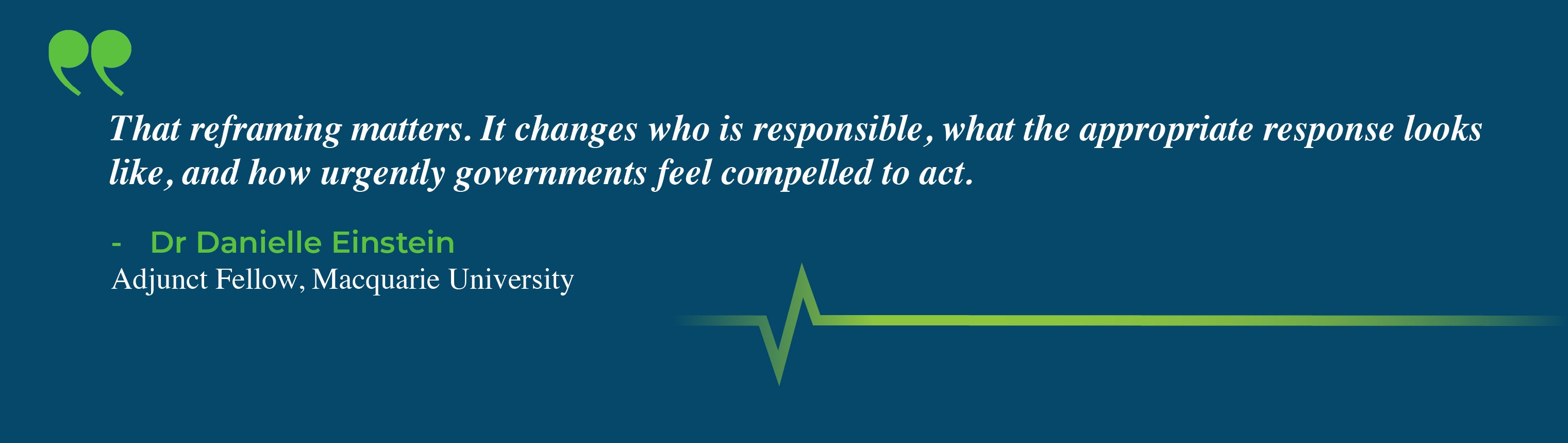
What is consistent across these varied approaches is the underlying shift in how the issue is being framed. This is no longer primarily a debate about platform regulation or parental responsibility. Increasingly, it is being treated as a question of public health and child development, a recognition that today’s digital environments are not passively used but actively engineered, with design features that influence behaviour, attention and emotional regulation during critical periods of adolescent development.
And it helps explain why, in the space of just two years, what was once seen as a fringe concern has become one of the defining child protection issues of our time.
What this means for Australia
For Australian schools, parents and communities, this global context matters. Australia’s reforms are not an isolated outlier, they are part of a much wider international effort to rethink how digital platforms operate for young people. Countries across Europe and Asia are now grappling with many of the same questions Australia has already begun to address, and in several cases are moving to go further.
At the same time, international developments are likely to shape the next phase of Australia’s own policy discussions. Spain’s proposal to hold technology executives personally accountable for platform failures raises a question that regulators in every country will eventually need to confront: whether protecting children online requires not only corporate compliance, but clear lines of responsibility within the leadership of the technology companies themselves.
Closer to home, the passage of Australia’s law is only the beginning. The risk now is that the legislation comes to be seen as a final fix rather than a first step. Research consistently shows that policy change alone does not shift behaviour, it creates the conditions for change. The mental health impacts of social media on adolescents, including increased rates of anxiety, depression, sleep disruption and body image concerns, did not emerge overnight, and they will not resolve simply because a law has been passed.
What is needed now is a coordinated public health response that matches the scale of the problem. For educators, that means professional development for all staff, clear policies and consistent enforcement. For students, it means co-designing programs that clearly name the harms, appeal to their desire for autonomy, and show how platforms exploit their emotions for profit, undermining that autonomy. For clinicians and health professionals, it means being equipped to have informed conversations with young patients and their families and feeling confident enough in the evidence to offer clear guidance rather than hedged advice. For parents, it means access to accurate, consistent information they can act on with confidence.
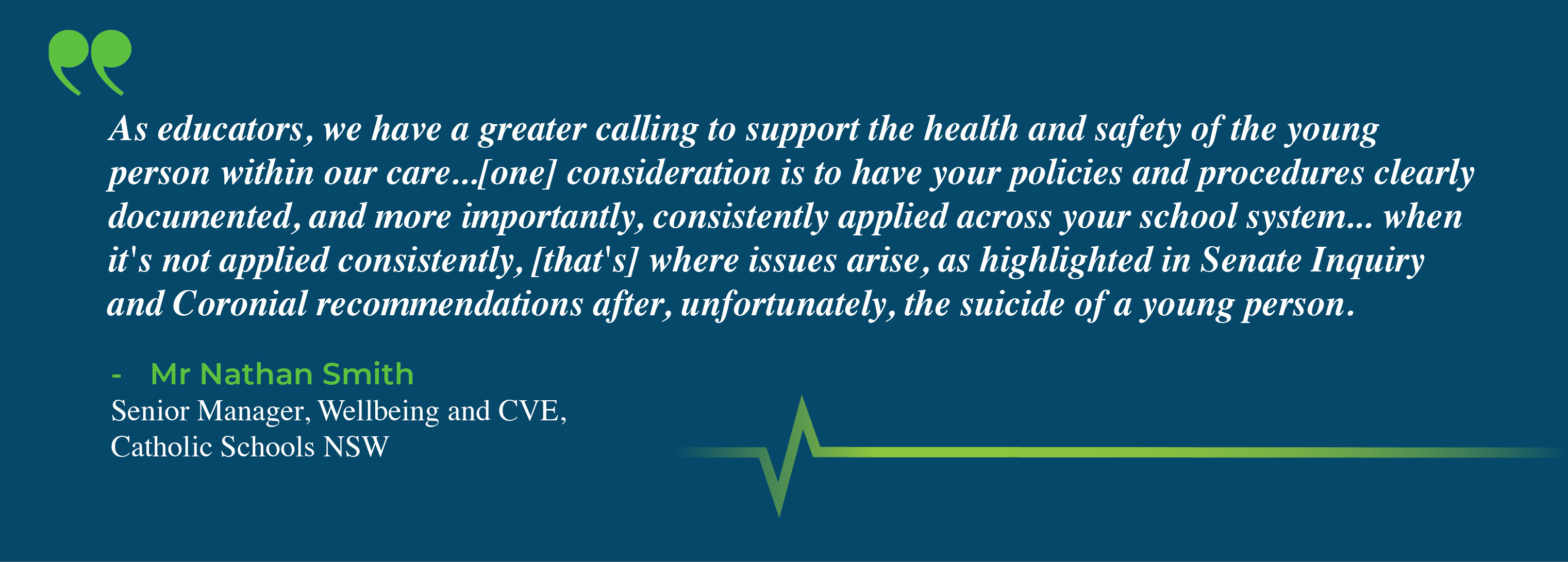
Passing a law changes what is permitted. What comes next, ensuring parents, educators and health professionals have the knowledge and confidence to act on it, is where the real work begins.
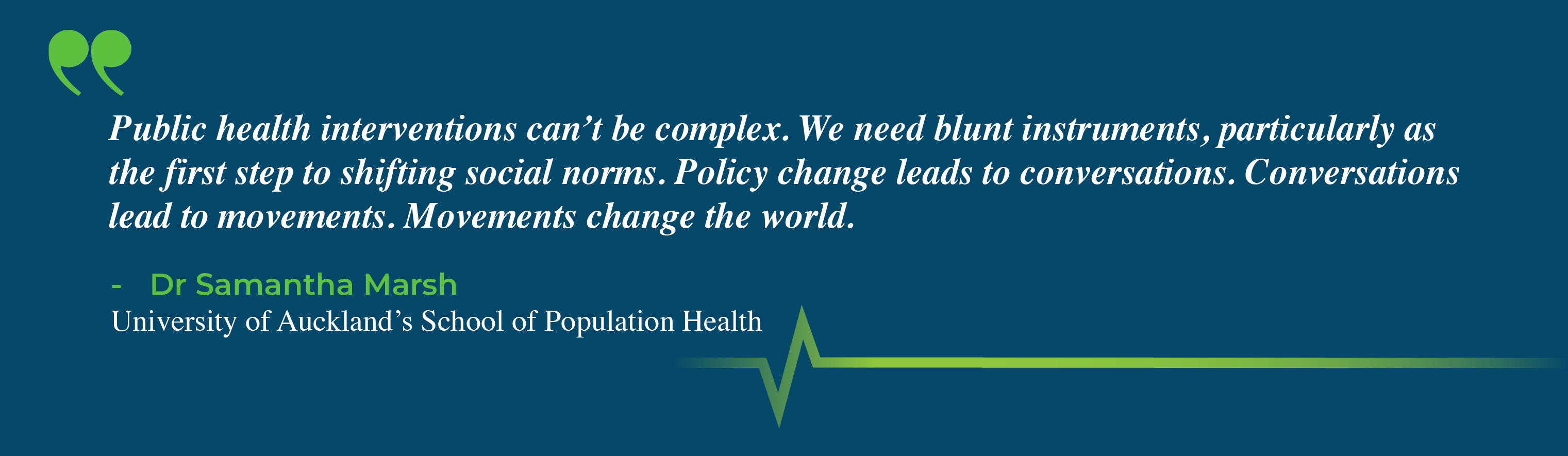
Dr Samantha Marsh of the University of Auckland’s School of Population Health captures the role of public health messaging:
The policy exists. The conversation has started. Now it is up to all of us to make sure it leads somewhere that matters.